Cooling Equipment for High-Temperature Furnaces | CXinduction

Necessary Auxiliary Equipment—Cooling Equipment for High-Temperature Furnaces

Two types of cooling device are available: the closed cooling tower and the air chiller. Choose according to footprint, power and budget.

Cooling equipment for high-temperature furnaces

Cooling Device Selection

The closed cooling tower uses water evaporation to absorb heat and cool the process fluid; the air chiller relies on a refrigerant compression cycle. The two options differ in power demand, footprint, price and compactness.

Need a solution for your project?

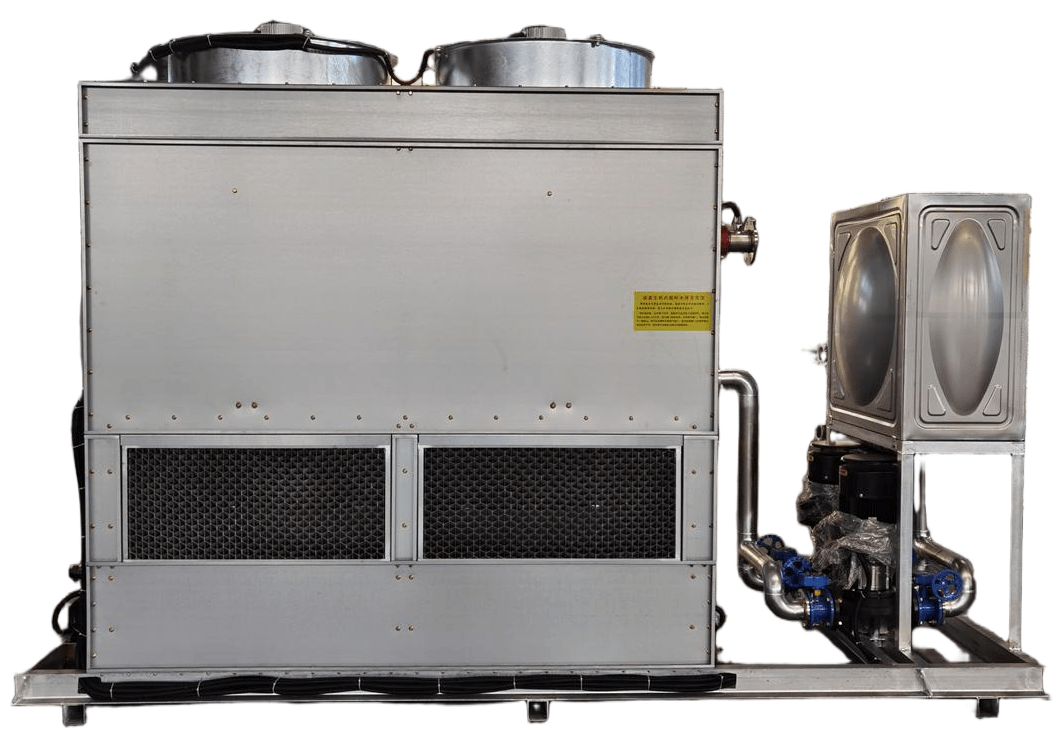
Closed Cooling Tower

Characteristics Smaller power and cheaper price, but requires a large footprint.
Heat Removal Principle Uses the principle of water evaporation absorbing heat to cool the process fluid.
Closed-Loop Fluid Spray water (cooling water) is stored at the tower bottom; the working fluid (softened water or other liquids) circulates in a closed loop through the coil tubes inside the tower.
Spray Cycle The spray system pumps water through a water distribution system and nozzles, evenly spraying it over the coil surface; a portion evaporates, absorbing heat and lowering the working fluid temperature inside the tubes.
Airflow and Recirculation Hot moist air and unevaporated water are intercepted by drift eliminators and pass through a PVC heat exchange layer; the water is cooled by the airflow, falls back into the sump, and is recirculated by the pump to the distribution system and sprayed onto the coils again.

Air Chiller

Characteristics Compact design, but requires a higher price and larger power.
Evaporation Liquid refrigerant in the evaporator absorbs heat from the water and begins to evaporate, forming a temperature difference between refrigerant and water; it completely evaporates into a gaseous state.
Compression The gaseous refrigerant is sucked in and compressed by the compressor, increasing pressure and temperature.
Condensation The gaseous refrigerant releases heat through the condenser and condenses into a liquid.
Throttling After being throttled by an expansion valve (or capillary tube), it becomes a low-temperature, low-pressure refrigerant.

联系