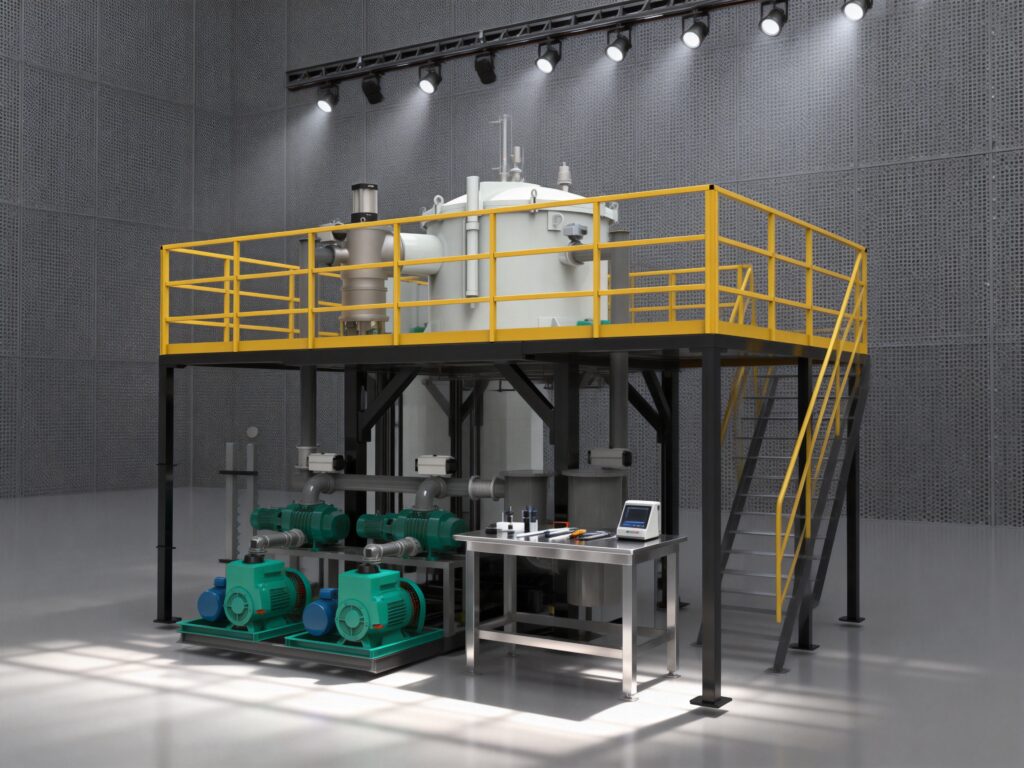
The rapid technological breakthrough of graphite fiber continuous graphitization furnace has completely upgraded the production mode of high-performance graphite materials. Featuring ±5℃ precise temperature control and AI real-time error correction technology, this advanced industrial equipment boosts graphite fiber tensile strength by 15% and cuts production cycle by 40%. As a core device in advanced material manufacturing, continuous graphitization furnaces have become indispensable equipment for aerospace, new energy, and 5G heat dissipation industries. This article explores the working principle, core advantages, technical differences of manufacturers, and industrial application value of continuous graphitization furnaces.
1. Continuous Graphitization Furnace: Leap from Laboratory to Industrial Mass Production
Traditional intermittent graphitization furnaces suffer from multiple temperature rise and fall processes, accompanied by high energy consumption, low efficiency, and unstable fiber quality. Different from outdated batch furnaces, the continuous graphitization furnace adopts a dynamic heating system to realize uninterrupted graphitization treatment. Graphite fibers move steadily inside the furnace and complete high-temperature graphitization in continuous operation.
Reliable manufacturers focus on three core technical indicators to guarantee equipment stability:
- Precision Temperature Control: The temperature control accuracy is controlled within ±5℃ to avoid internal cracking of graphite fibers caused by uneven thermal stress.
- Uniform Atmosphere Protection: Equipped with an inert gas circulation system to isolate oxygen and prevent oxidation damage to the fiber surface.
- Stable Material Transmission: Customized roller tables and traction devices ensure fiber deformation resistance under ultra-high temperature conditions.
2. Technical Differences Among Continuous Graphitization Furnace Manufacturers
Although the external structure of industrial graphitization furnaces is similar, subtle technical gaps directly determine fiber yield and production cost. Excellent manufacturers constantly optimize heating mode, furnace body materials, and intelligent control systems to upgrade equipment from “usable” to “excellent”.
2.1 Diversified Heating Technology
Resistance heating is widely used for its simple structure and low initial investment, while advanced induction heating technology improves thermal efficiency by more than 30%. Professional manufacturers solve electromagnetic shielding and material coupling problems, making induction heating the mainstream choice for high-end graphite fiber production.
2.2 High-temperature Resistant Furnace Body Material
The furnace lining refractory bricks need to withstand ultra-high temperature above 2500℃ and resist corrosion from graphite dust. The optimized insulation layer balances heat insulation performance and volume, effectively reducing heat loss and lowering long-term energy consumption.
2.3 AI Intelligent Control System
Top-ranking manufacturers integrate high-precision sensor networks and AI algorithms to build an intelligent production system. The system monitors furnace temperature, gas pressure, and atmosphere concentration in real time. Once tiny cracks appear on the fiber surface, the equipment automatically adjusts the heating rate and inert gas flow to prevent defect expansion, realizing active error correction and unmanned stable operation.
3. Industrial Impact: Promote Graphite Fiber Industry Transformation
The large-scale promotion of continuous graphitization furnaces has accelerated the transformation of the graphite fiber industry from extensive production to precision intelligent manufacturing. In terms of production benefits, continuous processing greatly reduces production costs, expanding the application scope of graphite fibers in new energy battery components and 5G base station heat dissipation materials.
In high-end manufacturing fields, mass production of high-strength graphite fibers supports lightweight composite materials. It effectively realizes energy conservation and emission reduction in aerospace, rail transit, and industrial precision manufacturing. Data shows that continuous graphitization technology increases fiber tensile strength by 15% and shortens the production cycle by 40%, bringing substantial economic benefits to downstream manufacturers.
4. How to Choose a Qualified Graphitization Furnace Manufacturer
For downstream material processing enterprises, selecting a professional continuous graphitization furnace manufacturer is the key to stable production. High-quality suppliers provide stable equipment operation, low defective rate, and shortened product R&D cycle. With the continuous improvement of advanced material performance standards, manufacturers with independent technical iteration capabilities will occupy a dominant position in the global market.
Conclusion
The technological iteration of graphite fiber continuous graphitization furnaces marks the upgrading of the global advanced material manufacturing industry. From ±5℃ precise temperature control to AI intelligent active correction, every technical optimization improves the performance and production efficiency of graphite fibers. If you are looking for high-temperature, energy-saving, and intelligent continuous graphitization equipment, please contact us for customized industrial furnace solutions to empower your graphite fiber production line.